Research web app · 2026
ZEROg
An autonomous research harness across NASA Open Science archives that turns statistical structure into biomedical leads.
ZEROg is a client-side-only interpretation theater over public NASA Open Science holdings — OSDR, GeneLab, ALSDA, and Microbial Tracking. A scientist picks one to nine corpora, launches the harness, watches leads materialize live, and leaves with a drafted, grant-ready research question. There is no backend and no network calls to NASA or a model; the runtime is a set of scripted agent modules for harness, corpus, leads, interpretation, and stage.
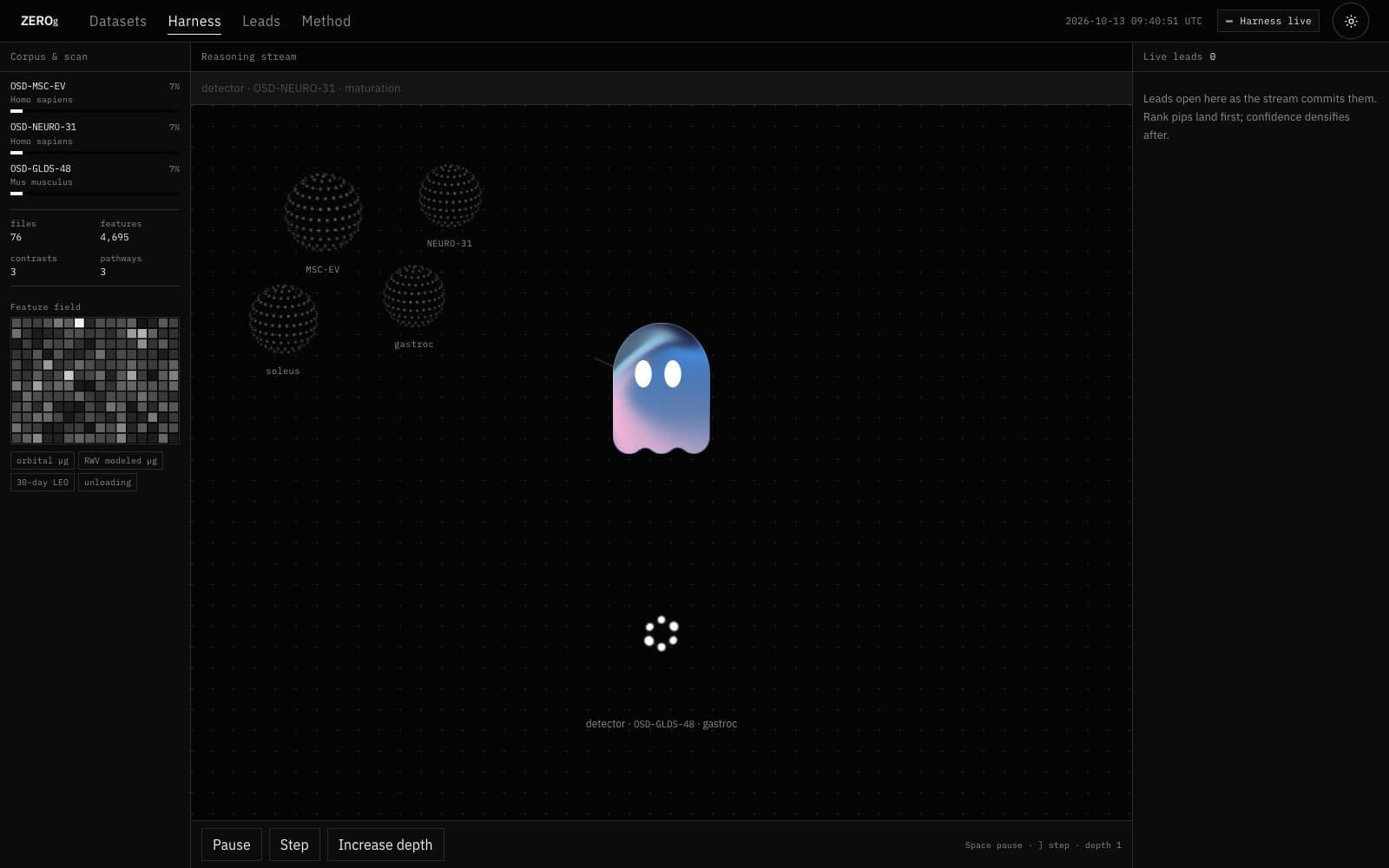
The nine-corpus catalog carries organism, tissue, assay, mission, sample, and file counts per dataset. The harness theater shows scan progress, live counters for files, features, contrasts, and pathways, a reasoning stream, and live lead cards, with Launch, Pause, Step, and depth controls on the keyboard (L, Space, ]) and a UTC mission clock.
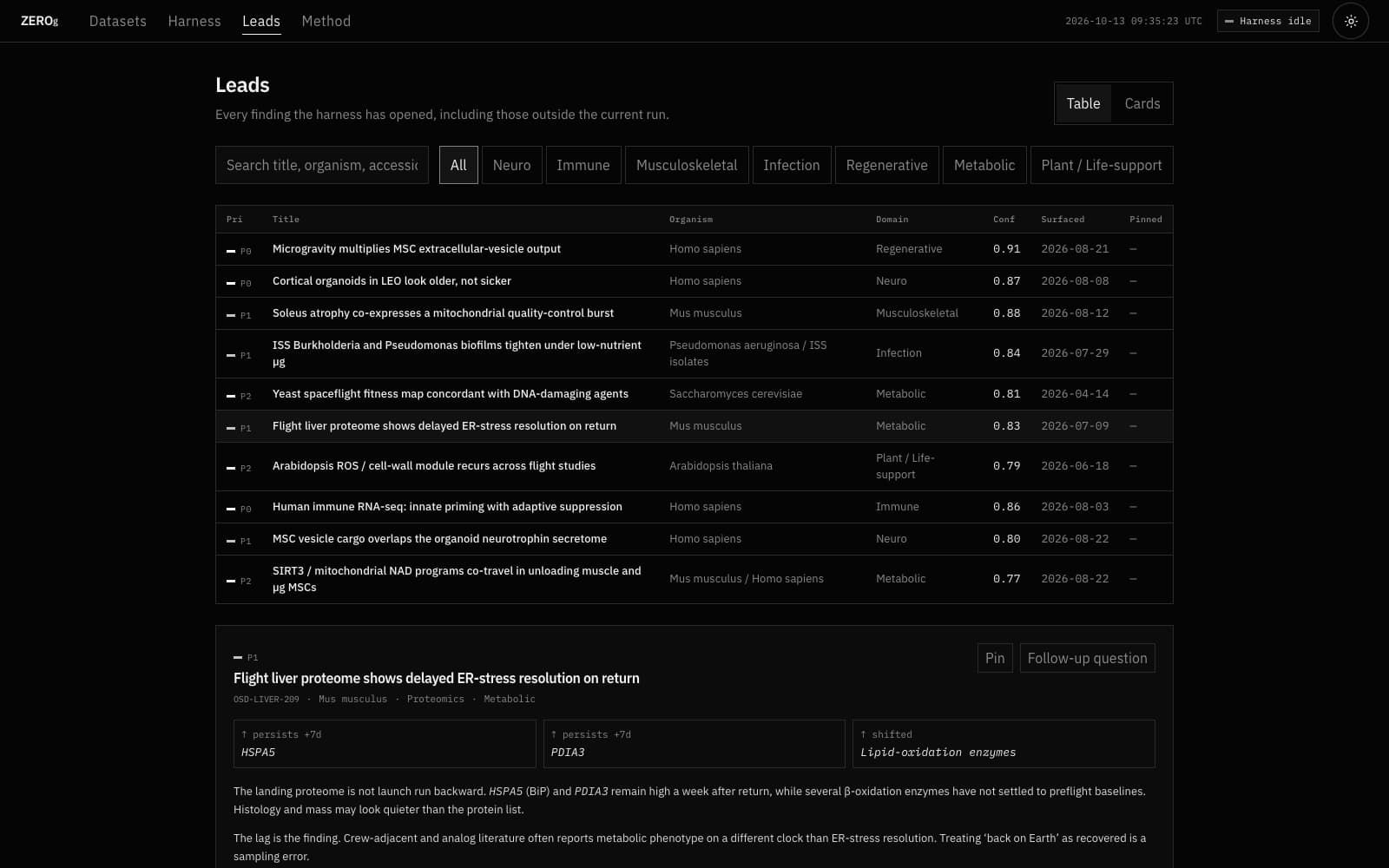
The ten-lead library gives each finding a science brief — biology, medicine, three signals, a three-part brief, a research question, and volcano, heatmap, and sparkline charts. Highlights include multiplied MSC extracellular-vesicle output in microgravity, cortical organoids that read older rather than sicker, and a soleus mitophagy burst. A planetarium stage with the ghost Gigi and role orbs frames the run, while the Method page explains the pipeline — Ingest, Contrast, Structure, Interpret — beside a searchable, filterable archive.
What it does
Corpus catalog
Nine NASA-style datasets with full provenance metadata, multi-select, filters, and a launch queue.
Harness theater
Live scan progress, counters, reasoning stream, and lead cards with launch, pause, step, and depth controls.
Lead library
Ten findings with confidence scores, science briefs, research questions, and volcano, heatmap, and sparkline charts.
Planetarium stage
A live scene with the ghost Gigi, detector, compute, critic, and interpreter orbs, gaze arcs, and a rotating dotted Earth.
Method as OS
The pipeline documented as Ingest, Contrast, Structure, and Interpret, with the archive searchable and filterable.
Built with
- React 19 with TypeScript, Vite build
- Tailwind CSS v4
- D3 with Visx chart primitives
- Framer Motion and Motion transitions
- Paper shaders, thinking orbs, NumberFlow
- IBM Plex Sans and Mono with Martian Mono for the curtain
- Zero backend — scripted client-side agent modules
ZEROg reads public NASA Open Science Data Repository holdings. Interpretation is generated by the research harness.